ارزیابی سناریومحور پذیرش سیاست تغییر کشت در میان کشاورزان استان کردستان: تلفیق مدل معادلات ساختاری، شبکه باور بیزی و مدلسازی عاملبنیان
کلمات کلیدی:
تغییر کشت, رفتار کشاورزان, تحلیل باور, شبکه باور بیزی, مدلسازی عاملبنیان, سیاست کشاورزیچکیده
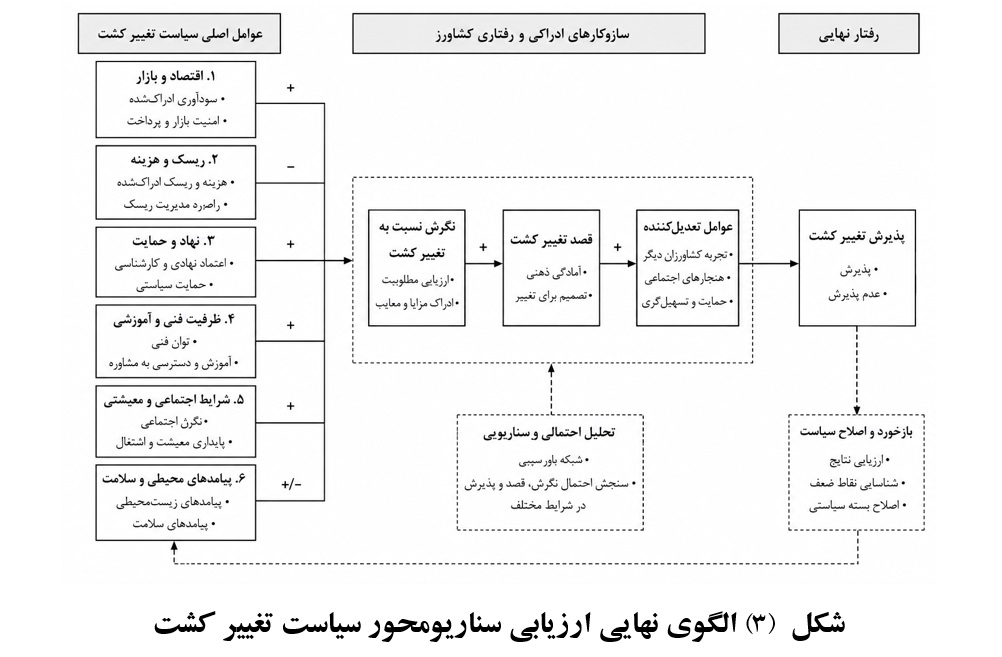
هدف این مطالعه، ارائه چارچوبی یکپارچه برای ارزیابی پذیرش سیاست تغییر کشت در شرایط عدمقطعیت بود. مطالعه با رویکرد آمیخته اکتشافی متوالی انجام شد. در مرحله کیفی، دادههای حاصل از مصاحبههای نیمهساختاریافته با ۲۰ نفر از کشاورزان و خبرگان حوزه کشاورزی با استفاده از روش تحلیل مضمون بررسی شد. در مرحله کمی، دادههای گردآوریشده از ۳۰۰ نفر از کشاورزان چهار شهرستان استان کردستان با روش مدلسازی معادلات ساختاری حداقل مربعات جزئی تحلیل شد. در ادامه، سازهها و روابط تأییدشده در قالب شبکه باور بیزی مدلسازی و، در کنار وضعیت پایه، شش سناریوی سیاستی ارزیابی شد. سپس خروجیهای احتمالی شبکه به مدل عاملبنیان انتقال یافت تا نرخ پذیرش تغییر کشت در سطح عاملهای کشاورز شبیهسازی شود. یافتههای کیفی به شناسایی هفت مضمون اصلی شامل اقتصاد و بازار، ریسک و تصمیم، نفوذ اجتماعی و اعتماد، سیاست و حمایت نهادی، ظرفیت فنی و ترویجی، محیطزیست و سلامت و معیشت و رفتار تغییر کشت انجامید. نتایج مدل ساختاری نشان داد مزیت اقتصادی، امنیت بازار، اعتماد نهادی، نفوذ اجتماعی و توان فنی، متناسب با مسیرهای مدل، بر نگرش، قصد یا رفتار تغییر کشت اثر مثبت دارند؛ در مقابل، هزینه و ریسک ادراکشده و پیامدهای محیطزیستی و سلامت، نقش بازدارنده ایفا میکنند. ضریب تعیین نگرش برابر با ۰٫۶۴۴ و ضریب تعیین قصد و رفتار برابر با ۰٫۷۱۶ بود و مقدار شاخص برازش استانداردشده ۰٫۰۴۹ به دست آمد. نتایج شبکه باور بیزی نشان داد احتمال قصد بالای تغییر کشت از ۲۵٫۸۷ درصد در وضعیت پایه به ۵۴٫۲۳ درصد در سناریوی مطلوب افزایش یافت، درحالیکه این احتمال در سناریوی نامطلوب به ۱۱٫۰۱ درصد کاهش پیدا کرد. همچنین، مدل عاملبنیان نشان داد نرخ پذیرش تغییر کشت از ۵۳ درصد در وضعیت پایه به ۷۴ درصد در سناریوی مطلوب افزایش یافت و در سناریوی نامطلوب به ۳۱٫۶۷ درصد کاهش یافت. برآیند یافتهها نشان میدهد موفقیت سیاست تغییر کشت به طراحی و اجرای بستهای هماهنگ شامل سودآوری اقتصادی، امنیت بازار، کاهش ریسک، حمایت نهادی، آموزش عملی و اعتمادسازی وابسته است.
مراجع
Ajzen, I. (1991). The theory of planned behavior. Organizational Behavior and Human Decision Processes, 50(2), 179–211. https://doi.org/10.1016/0749-5978(91)90020-T
Al Gouhmani, H., Lagou, I., Vardavas, A. I., & Vardavas, C. (2023). Heated tobacco products: A new challenge for environmental impact assessment. Public Health and Toxicology, 3(4), Article 23. https://doi.org/10.18332/pht/178088
Ali, M. Y., Shahrier, M., Al Kafy, A. A., Ara, I., Javed, A., Fattah, M. A., Rahaman, Z. A., & Tripura, K. (2023). Environmental impact assessment of tobacco farming in northern Bangladesh. Heliyon, 9(3), Article e14505. https://doi.org/10.1016/j.heliyon.2023.e14505
Alonso-Adame, A., Van Meensel, J., Marchand, F., Van Passel, S., & Farahbakhsh, S. (2024). Sustainability transitions in agri-food systems through the lens of agent-based modeling: A systematic review. Sustainability Science, 19, 2101–2118. https://doi.org/10.1007/s11625-024-01551-0
An, L. (2012). Modeling human decisions in coupled human and natural systems: Review of agent-based models. Ecological Modelling, 229, 25–36. https://doi.org/10.1016/j.ecolmodel.2011.07.010
Appau, A., Drope, J., Goma, F., Magati, P., Labonté, R., Makoka, D., Zulu, R., Li, Q., & Lencucha, R. (2020). Explaining why farmers grow tobacco: Evidence from Malawi, Kenya, and Zambia. Nicotine & Tobacco Research, 22(12), 2238–2245. https://doi.org/10.1093/ntr/ntz173
Braun, V., & Clarke, V. (2006). Using thematic analysis in psychology. Qualitative Research in Psychology, 3(2), 77–101. https://doi.org/10.1191/1478088706qp063oa
Dessart, F. J., Barreiro-Hurlé, J., & van Bavel, R. (2019). Behavioural factors affecting the adoption of sustainable farming practices: A policy-oriented review. European Review of Agricultural Economics, 46(3), 417–471. https://doi.org/10.1093/erae/jbz019
Di Bene, C., Gómez-López, M. D., Francaviglia, R., Farina, R., Blasi, E., Martínez-Granados, D., & Calatrava, J. (2022). Barriers and opportunities for sustainable farming practices and crop diversification strategies in Mediterranean cereal-based systems. Frontiers in Environmental Science, 10, Article 861225. https://doi.org/10.3389/fenvs.2022.861225
El Fartassi, I., Milne, A. E., Metcalfe, H., El Alami, R., Diarra, A., Alonso-Chavez, V., Zawadzka, J., Waine, T. W., & Corstanje, R. (2025). An agent-based model of farmer decision making: Application to shared water resources in arid and semi-arid regions. Agricultural Water Management, 310, Article 109357. https://doi.org/10.1016/j.agwat.2025.109357
Ghanbari, R., Azizi, K., & Gholamrezaei, S. (2020). Psychological factors affecting farmers’ intention to diversify agricultural products: A case study of Khorramabad County [In Persian]. Iranian Journal of Agricultural Economics and Development Research, 51(2), 279–293.
Hair, J. F., Hult, G. T. M., Ringle, C. M., & Sarstedt, M. (2022). A primer on partial least squares structural equation modeling (PLS-SEM) (3rd ed.). SAGE Publications.
Huet, E. K., Adam, M., Giller, K. E., & Descheemaeker, K. (2020). Diversity in perception and management of farming risks in southern Mali. Agricultural Systems, 184, Article 102905. https://doi.org/10.1016/j.agsy.2020.102905
Kor, A., Naderi Mahdei, K., Shanazi, K., & Esfahani, S. M. J. (2023). Study of the environmental sustainability of tobacco (Nicotiana tabacum) cultivation using an ecological footprint approach: A case study of flue-cured and air-cured tobacco in Golestan Province [In Persian]. Journal of Agroecology, 15(3), 607–624. https://doi.org/10.22067/agry.2021.71190.1055
Landuyt, D., Broekx, S., D’hondt, R., Engelen, G., Aertsens, J., & Goethals, P. L. M. (2013). A review of Bayesian belief networks in ecosystem service modelling. Environmental Modelling & Software, 46, 1–11. https://doi.org/10.1016/j.envsoft.2013.03.011
Lin, B. B. (2011). Resilience in agriculture through crop diversification: Adaptive management for environmental change. BioScience, 61(3), 183–193. https://doi.org/10.1525/bio.2011.61.3.4
Meijer, S. S., Catacutan, D., Ajayi, O. C., Sileshi, G. W., & Nieuwenhuis, M. (2015). The role of knowledge, attitudes, and perceptions in the uptake of agricultural and agroforestry innovations among smallholder farmers in sub-Saharan Africa. International Journal of Agricultural Sustainability, 13(1), 40–54. https://doi.org/10.1080/14735903.2014.912493
Mousavi Moayed, S. A., Nooripoor, M., & Afereydouni, M. (2024). Investigating farmers’ opinions toward switching to crops with lower water requirements: A case study of the Margoon region [In Persian]. Agricultural and Rural Economics, 2(1), 51–76. https://doi.org/10.30490/etr.2024.365688.1021
Rahmatzadeh, M., Pirdashti, H., Esmaeeli, M. A., Abasi, R., & Yaghoubian, Y. (2024). The effect of nutrition management and planting pattern on the quantitative and qualitative characteristics of two Virginia tobacco (Nicotiana tabacum L.) cultivars [In Persian]. Journal of Agricultural Science and Sustainable Production, 34(3), 55–67. https://doi.org/10.22034/saps.2023.56207.3024
Ravaioli, G., Domingos, T., & Teixeira, R. F. M. (2023). A framework for data-driven agent-based modelling of agricultural land use. Land, 12(4), Article 756. https://doi.org/10.3390/land12040756
Rivera, M., Knickel, K., Díaz-Puente, J. M., & Afonso, A. (2019). The role of social capital in agricultural and rural development: Lessons learnt from case studies in seven countries. Sociologia Ruralis, 59(1), 66–91. https://doi.org/10.1111/soru.12218
Rogers, E. M. (2003). Diffusion of innovations (5th ed.). Free Press.
Sahadewo, G. A., Drope, J., Li, Q., Witoelar, F., & Lencucha, R. (2020). In-and-out of tobacco farming: Shifting behavior of tobacco farmers in Indonesia. International Journal of Environmental Research and Public Health, 17(24), Article 9416. https://doi.org/10.3390/ijerph17249416
Solimani, M., Rahimi, D., & Yazdanpanah, H. (2021). Climate change adaptation strategies in the agricultural sector: A case study of Rostam County [In Persian]. Journal of Natural Environmental Hazards, 10(29), 19–32. https://doi.org/10.22111/jneh.2020.32681.1598
Sun, Z., & Müller, D. (2013). A framework for modeling payments for ecosystem services with agent-based models, Bayesian belief networks, and opinion dynamics models. Environmental Modelling & Software, 45, 15–28. https://doi.org/10.1016/j.envsoft.2012.06.007
Will, M., Bartkowski, B., Schwarz, N., Wittstock, F., Grujić, N., Li, C., Ge, J., Ziv, G., & Müller, B. (2024). From primary data to formalized decision-making: Open challenges and ways forward to inform representations of farmers’ behavior in agent-based models. Ecology and Society, 29(4), Article 31. https://doi.org/10.5751/ES-15400-290431
دانلود
گاهشمار انتشار
- ارسال
- بازنگری
- پذیرش
شماره
نوع مقاله
مجوز
حق نشر 2026 وریا سلیمی (نویسنده); مرتضی محمودزاده (نویسنده مسئول)، میرحسین سیدی (نویسنده)

این پروژه تحت مجوز بین المللی Creative Commons Attribution-NonCommercial 4.0 می باشد.