Scenario-Based Evaluation of Farmers’ Acceptance of Crop-Switching Policy in Kurdistan Province: Integrating Structural Equation Modeling, Bayesian Belief Networks, and Agent-Based Modeling
Keywords:
crop switching, farmer behavior, belief analysis, Bayesian belief network, agent-based modeling, agricultural policyAbstract
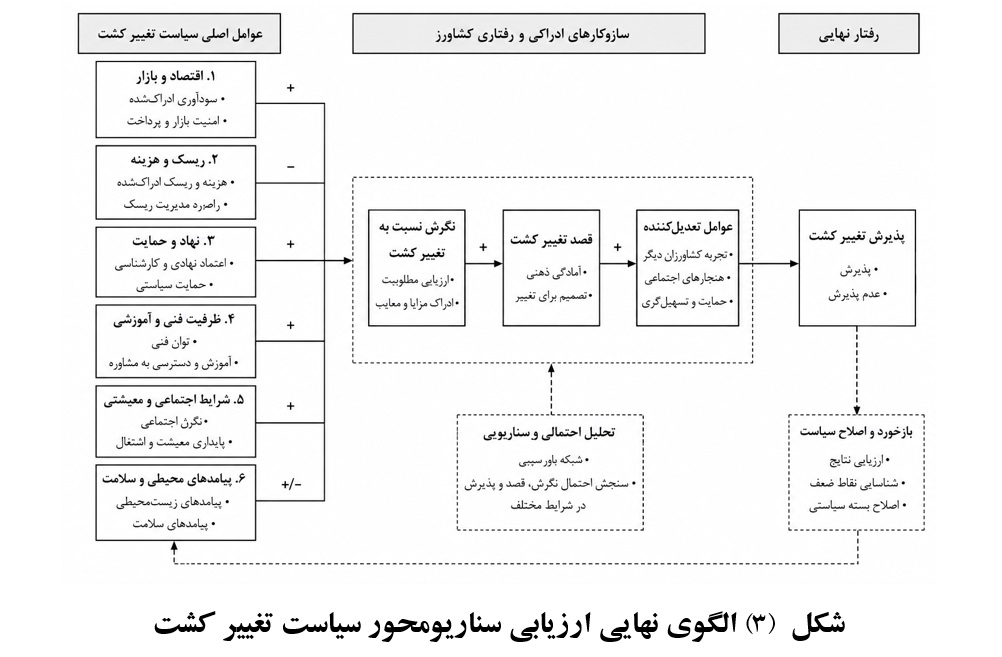
This study aimed to develop an integrated framework for evaluating the acceptance of crop-switching policy under conditions of uncertainty. The study employed an exploratory sequential mixed-methods design. In the qualitative phase, data obtained from semi-structured interviews with 20 farmers and agricultural experts were analyzed using thematic analysis. In the quantitative phase, data collected from 300 farmers across four counties in Kurdistan Province were analyzed using partial least squares structural equation modeling (PLS-SEM). Subsequently, the validated constructs and relationships were modeled within a Bayesian belief network, and six policy scenarios were evaluated alongside the baseline scenario. The network’s probabilistic outputs were then transferred to an agent-based model to simulate the crop-switching adoption rate at the level of individual farmer agents. The qualitative findings identified seven major themes: economics and markets, risk and decision-making, social influence and trust, policy and institutional support, technical and extension capacity, environment and health, and livelihoods and crop-switching behavior. The structural model results indicated that economic advantage, market security, institutional trust, social influence, and technical capacity positively affected attitudes, intentions, or crop-switching behavior, depending on the specified model pathways. In contrast, perceived costs and risks and environmental and health consequences exerted inhibitory effects. The coefficient of determination was 0.644 for attitudes and 0.716 for intentions and behavior, while the standardized root mean square residual was 0.049. The Bayesian belief network results showed that the probability of a high intention to switch crops increased from 25.87% under the baseline scenario to 54.23% under the favorable scenario, whereas it decreased to 11.01% under the unfavorable scenario. Furthermore, the agent-based model showed that the crop-switching adoption rate increased from 53% under the baseline scenario to 74% under the favorable scenario and declined to 31.67% under the unfavorable scenario. Overall, the findings indicate that the success of crop-switching policy depends on designing and implementing a coordinated policy package encompassing economic profitability, market security, risk reduction, institutional support, practical training, and trust-building.
References
Ajzen, I. (1991). The theory of planned behavior. Organizational Behavior and Human Decision Processes, 50(2), 179–211. https://doi.org/10.1016/0749-5978(91)90020-T
Al Gouhmani, H., Lagou, I., Vardavas, A. I., & Vardavas, C. (2023). Heated tobacco products: A new challenge for environmental impact assessment. Public Health and Toxicology, 3(4), Article 23. https://doi.org/10.18332/pht/178088
Ali, M. Y., Shahrier, M., Al Kafy, A. A., Ara, I., Javed, A., Fattah, M. A., Rahaman, Z. A., & Tripura, K. (2023). Environmental impact assessment of tobacco farming in northern Bangladesh. Heliyon, 9(3), Article e14505. https://doi.org/10.1016/j.heliyon.2023.e14505
Alonso-Adame, A., Van Meensel, J., Marchand, F., Van Passel, S., & Farahbakhsh, S. (2024). Sustainability transitions in agri-food systems through the lens of agent-based modeling: A systematic review. Sustainability Science, 19, 2101–2118. https://doi.org/10.1007/s11625-024-01551-0
An, L. (2012). Modeling human decisions in coupled human and natural systems: Review of agent-based models. Ecological Modelling, 229, 25–36. https://doi.org/10.1016/j.ecolmodel.2011.07.010
Appau, A., Drope, J., Goma, F., Magati, P., Labonté, R., Makoka, D., Zulu, R., Li, Q., & Lencucha, R. (2020). Explaining why farmers grow tobacco: Evidence from Malawi, Kenya, and Zambia. Nicotine & Tobacco Research, 22(12), 2238–2245. https://doi.org/10.1093/ntr/ntz173
Braun, V., & Clarke, V. (2006). Using thematic analysis in psychology. Qualitative Research in Psychology, 3(2), 77–101. https://doi.org/10.1191/1478088706qp063oa
Dessart, F. J., Barreiro-Hurlé, J., & van Bavel, R. (2019). Behavioural factors affecting the adoption of sustainable farming practices: A policy-oriented review. European Review of Agricultural Economics, 46(3), 417–471. https://doi.org/10.1093/erae/jbz019
Di Bene, C., Gómez-López, M. D., Francaviglia, R., Farina, R., Blasi, E., Martínez-Granados, D., & Calatrava, J. (2022). Barriers and opportunities for sustainable farming practices and crop diversification strategies in Mediterranean cereal-based systems. Frontiers in Environmental Science, 10, Article 861225. https://doi.org/10.3389/fenvs.2022.861225
El Fartassi, I., Milne, A. E., Metcalfe, H., El Alami, R., Diarra, A., Alonso-Chavez, V., Zawadzka, J., Waine, T. W., & Corstanje, R. (2025). An agent-based model of farmer decision making: Application to shared water resources in arid and semi-arid regions. Agricultural Water Management, 310, Article 109357. https://doi.org/10.1016/j.agwat.2025.109357
Ghanbari, R., Azizi, K., & Gholamrezaei, S. (2020). Psychological factors affecting farmers’ intention to diversify agricultural products: A case study of Khorramabad County [In Persian]. Iranian Journal of Agricultural Economics and Development Research, 51(2), 279–293.
Hair, J. F., Hult, G. T. M., Ringle, C. M., & Sarstedt, M. (2022). A primer on partial least squares structural equation modeling (PLS-SEM) (3rd ed.). SAGE Publications.
Huet, E. K., Adam, M., Giller, K. E., & Descheemaeker, K. (2020). Diversity in perception and management of farming risks in southern Mali. Agricultural Systems, 184, Article 102905. https://doi.org/10.1016/j.agsy.2020.102905
Kor, A., Naderi Mahdei, K., Shanazi, K., & Esfahani, S. M. J. (2023). Study of the environmental sustainability of tobacco (Nicotiana tabacum) cultivation using an ecological footprint approach: A case study of flue-cured and air-cured tobacco in Golestan Province [In Persian]. Journal of Agroecology, 15(3), 607–624. https://doi.org/10.22067/agry.2021.71190.1055
Landuyt, D., Broekx, S., D’hondt, R., Engelen, G., Aertsens, J., & Goethals, P. L. M. (2013). A review of Bayesian belief networks in ecosystem service modelling. Environmental Modelling & Software, 46, 1–11. https://doi.org/10.1016/j.envsoft.2013.03.011
Lin, B. B. (2011). Resilience in agriculture through crop diversification: Adaptive management for environmental change. BioScience, 61(3), 183–193. https://doi.org/10.1525/bio.2011.61.3.4
Meijer, S. S., Catacutan, D., Ajayi, O. C., Sileshi, G. W., & Nieuwenhuis, M. (2015). The role of knowledge, attitudes, and perceptions in the uptake of agricultural and agroforestry innovations among smallholder farmers in sub-Saharan Africa. International Journal of Agricultural Sustainability, 13(1), 40–54. https://doi.org/10.1080/14735903.2014.912493
Mousavi Moayed, S. A., Nooripoor, M., & Afereydouni, M. (2024). Investigating farmers’ opinions toward switching to crops with lower water requirements: A case study of the Margoon region [In Persian]. Agricultural and Rural Economics, 2(1), 51–76. https://doi.org/10.30490/etr.2024.365688.1021
Rahmatzadeh, M., Pirdashti, H., Esmaeeli, M. A., Abasi, R., & Yaghoubian, Y. (2024). The effect of nutrition management and planting pattern on the quantitative and qualitative characteristics of two Virginia tobacco (Nicotiana tabacum L.) cultivars [In Persian]. Journal of Agricultural Science and Sustainable Production, 34(3), 55–67. https://doi.org/10.22034/saps.2023.56207.3024
Ravaioli, G., Domingos, T., & Teixeira, R. F. M. (2023). A framework for data-driven agent-based modelling of agricultural land use. Land, 12(4), Article 756. https://doi.org/10.3390/land12040756
Rivera, M., Knickel, K., Díaz-Puente, J. M., & Afonso, A. (2019). The role of social capital in agricultural and rural development: Lessons learnt from case studies in seven countries. Sociologia Ruralis, 59(1), 66–91. https://doi.org/10.1111/soru.12218
Rogers, E. M. (2003). Diffusion of innovations (5th ed.). Free Press.
Sahadewo, G. A., Drope, J., Li, Q., Witoelar, F., & Lencucha, R. (2020). In-and-out of tobacco farming: Shifting behavior of tobacco farmers in Indonesia. International Journal of Environmental Research and Public Health, 17(24), Article 9416. https://doi.org/10.3390/ijerph17249416
Solimani, M., Rahimi, D., & Yazdanpanah, H. (2021). Climate change adaptation strategies in the agricultural sector: A case study of Rostam County [In Persian]. Journal of Natural Environmental Hazards, 10(29), 19–32. https://doi.org/10.22111/jneh.2020.32681.1598
Sun, Z., & Müller, D. (2013). A framework for modeling payments for ecosystem services with agent-based models, Bayesian belief networks, and opinion dynamics models. Environmental Modelling & Software, 45, 15–28. https://doi.org/10.1016/j.envsoft.2012.06.007
Will, M., Bartkowski, B., Schwarz, N., Wittstock, F., Grujić, N., Li, C., Ge, J., Ziv, G., & Müller, B. (2024). From primary data to formalized decision-making: Open challenges and ways forward to inform representations of farmers’ behavior in agent-based models. Ecology and Society, 29(4), Article 31. https://doi.org/10.5751/ES-15400-290431
Downloads
Publication Timeline
- Submitted
- Revised
- Accepted
Issue
Section
License
Copyright (c) 2026 وریا سلیمی (نویسنده); مرتضی محمودزاده (نویسنده مسئول)، میرحسین سیدی (نویسنده)

This work is licensed under a Creative Commons Attribution-NonCommercial 4.0 International License.