Development and Validation of a Causal Model for Assessing Energy Imbalance in Iran’s Gas Industry
Keywords:
gas imbalance, consumption patterns, energy governance, gas infrastructure, energy efficiency, temporal dynamics, structural equation modelingAbstract
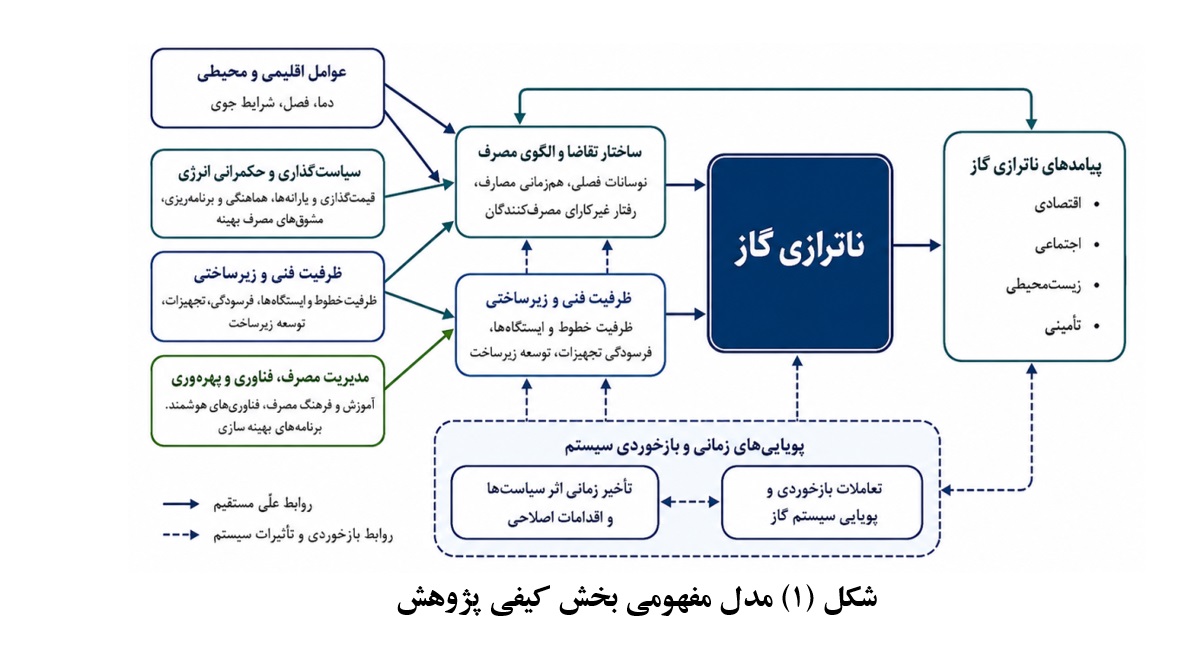
This study aimed to identify and explain the factors influencing the severity of the gas imbalance, examine its consequences, and develop an integrated causal model. In terms of purpose, the study was applied, and methodologically, it employed an exploratory sequential mixed-methods design. Participants in the qualitative phase consisted of experts, managers, and specialists knowledgeable about issues related to the gas and energy industries. Data were collected through semi-structured interviews until theoretical saturation was reached and were subsequently analyzed. The statistical population of the quantitative phase comprised individuals with relevant knowledge and experience in the gas and energy sectors. Data from 300 respondents were examined using a researcher-developed 40-item questionnaire. Quantitative data were analyzed using SPSS and SmartPLS software and partial least squares structural equation modeling (PLS-SEM). The qualitative findings indicated that the gas imbalance is a multidimensional and systemic phenomenon. Its determinants were classified into six principal dimensions: demand pressure and consumption patterns; the quality of energy policymaking and governance; infrastructure capacity and reliability; demand-side management, technology, and efficiency; climatic and environmental pressures; and temporal and feedback complexities. The severity of the gas imbalance was also identified as the central construct, while its economic, industrial, social, environmental, and security consequences were identified as the model’s ultimate outcomes. The quantitative results confirmed the satisfactory reliability and validity of the measurement model and demonstrated that all seven research hypotheses were statistically significant. Demand pressure and consumption patterns, with a path coefficient of 0.291; temporal and feedback complexities, with a coefficient of 0.267; and climatic and environmental pressures, with a coefficient of 0.160, had positive and significant effects on the severity of the gas imbalance. Conversely, infrastructure capacity and reliability, with a coefficient of −0.256; the quality of energy policymaking and governance, with a coefficient of −0.201; and demand-side management, technology, and efficiency, with a coefficient of −0.147, had negative and significant effects on the severity of the imbalance. Furthermore, the severity of the gas imbalance had a strong positive effect on its consequences, with a path coefficient of 0.712. Collectively, the six predictor variables explained 62.9% of the variance in the severity of the gas imbalance, while the severity of the imbalance explained 50.6% of the variance in its consequences. The predictive relevance index values for the severity of the imbalance and its consequences were 0.408 and 0.316, respectively, and the model’s overall fit was assessed as acceptable and relatively satisfactory. Overall, the findings demonstrated that the gas imbalance is not attributable to a single factor and that its sustainable reduction requires simultaneous interventions in demand management, infrastructure development and modernization, governance reform, improvements in efficiency and technology, and the management of climatic impacts and time delays.
References
Abbasi, J. (2017). Evaluation of gas supply-and-demand dynamics in Iran’s residential sector. Energy Research Journal, 9(3), 62–87.
Amiri, Z., Mohammadian Saravi, M., & Karimi Gorji, S. M. (2024). The role of smart technologies in improving energy policies and reducing the gas imbalance. Futures Studies and Policy-Making Studies, 10(3), 25–31.
Arpino, F., Dell’Isola, M., Ficco, G., & Vigo, P. (2014). Unaccounted-for gas in natural gas transmission networks: Prediction and analysis. IFAC Proceedings Volumes, 46(9), 1123–1127.
Botev, L., & Johnson, P. (2020). Applications of statistical process control in the management of unaccounted-for gas. Journal of Natural Gas Science and Engineering, 76, Article 103194. https://doi.org/10.1016/j.jngse.2020.103194
Farhadi, S. (2019). The effect of energy subsidy reform policies on the national gas balance. Iranian Journal of Economic Research, 21(4), 34–59.
Faryadres, S., Khani, A., & Rouhi, A. (2025). Dynamic modeling of gas consumption and pricing policies in Iran. International Journal of Energy Studies, 41(2), 77–98.
Gao, H., Wu, Y., & Chen, T. (2025). Structural equation modeling of energy imbalance and demand elasticity: Evidence from East Asia. Applied Energy, 370(5), 118–134.
Habibi, M., & Naderi, K. (2018). Price- and climate-related effects on natural gas consumption patterns. Iranian Journal of Energy Economics, 19(1), 45–68.
Heidari, F., & Nasiri, M. (2015). Energy data analysis using a system dynamics approach. Energy Engineering Quarterly, 6(3), 11–29.
Hosseini, S. (2019). An examination of natural gas consumption patterns in Iran’s power-generation sector. Journal of Engineering and the Environment, 11(2), 81–102.
Iran Energy Studies Institute. (2023). Annual report on the national gas imbalance and corrective strategies. Ministry of Petroleum.
Iran Renewable Energy Organization (SANA). (2021). Energy balance report 2021. Ministry of Energy.
Jafari, N., & Mahmoudi, F. (2022). A causal model of the effects of energy policies on natural gas consumption intensity. Journal of Energy Planning, 15(4), 92–115.
Kani, A., Abbaspour, M., & Abedi, M. (2013). Natural gas demand function in Iran: A STR approach. Journal of Natural Gas Science and Engineering, 17, 58–70. https://doi.org/10.1016/j.jngse.2014.01.003
Karimi, R., & Yousefi, M. (2019). Challenges associated with the natural gas imbalance and consumption optimization policies in Iran. Journal of Energy Economics and Management, 24(1), 54–77.
Kazemi, A., & Rezaei, D. (2021). Evaluation of energy efficiency and pricing policies in Iran’s residential gas sector. Energy Economics Quarterly, 23(2), 67–90.
Kiarts, R., & Johansen, T. (2019). Smart energy management systems for gas distribution networks. Energy Technology Journal, 14(2), 119–145.
Lee, J., & Park, S. (2023). Modeling feedback loops in national gas supply systems. Energy Economics, 122(3), 204–221.
Manara, C. (2024). Integrating SEM and SD models to study household gas demand in Europe. Energy Systems Review, 12(1), 89–105.
Mirzaei, S. (2022). Examining the effects of emerging technologies on gas consumption optimization in the industrial sector. Journal of Energy Technology, 10(3), 40–58.
Mohammadpoor, M., & Torabi, F. (2018). Big data analytics in oil and gas industry: An emerging trend. Petroleum. https://doi.org/10.1016/j.petlm.2018.11.001
Nemati, R., & Talebi, H. (2020). A systems analysis of the gas imbalance and the effects of environmental variables. Journal of Economics and Energy Research, 18(1), 70–95.
Rajabi, H., & Sadeghi-Shahdani, M. (2025). An analysis of pricing policies and natural gas consumer behavior in Iran. Iranian Economic Research Quarterly, 25(1), 55–78.
Salehi, N. (2016). A systems model of residential gas consumption with an emphasis on pricing policies. Iranian Journal of Energy Management, 7(2), 25–49.
Sedigaz. (2020). World natural gas report: Global balance, consumption, and trade patterns. Sedigaz Press.
Shafiq, M., Nisar, W. B., Savino, M. M., Rashid, Z., & Ahmad, Z. (2018). Monitoring and controlling of unaccounted-for gas (UFG) in distribution networks: A case study of SNGPL Pakistan. IFAC-PapersOnLine, 51(11), 253–258. https://doi.org/10.1016/j.ifacol.2018.08.284
Soleimani, M. (2023). An examination of the factors affecting energy efficiency in Iran’s gas-intensive industries. Iranian Journal of Energy Management, 8(2), 45–63.
Statistical Center of Iran. (2014). Statistical report on natural gas consumption in Iran. Plan and Budget Organization.
Sterman, J. D. (2000). Business dynamics: Systems thinking and modeling for a complex world. Irwin/McGraw-Hill.
Upadhyay, D., & Sampalli, S. (2020). SCADA systems: Vulnerability assessment and security recommendations. Computers & Security, 89, Article 101666. https://doi.org/10.1016/j.cose.2019.101666
Yang, L., Li, X., & Zhang, M. (2025). A system dynamics approach to modeling natural gas balance in developing economies. Energy Policy, 193(4), 122–137.
Yazdani, P. (2020). The role of technical infrastructure in reducing the gas imbalance in Iran. Journal of Energy Engineering, 5(2), 23–46.
Zafarian, A., Saberi, H., & Nasab-Nikkhah, M. (2023). The national natural gas imbalance (Part 2): A framework of proposed solutions. Islamic Parliament Research Center.
Zhao, R., & Chen, L. (2023). Evaluating energy efficiency improvement and gas consumption behavior. Journal of Cleaner Production, 396(2), 45–61.
Downloads
Publication Timeline
- Submitted
- Revised
- Accepted
Issue
Section
License
Copyright (c) 1405 رضا عبدالعلی زاده (نویسنده); مرتضی محمودزاده (نویسنده مسئول)

This work is licensed under a Creative Commons Attribution-NonCommercial 4.0 International License.