Design and Evaluation of a Novel Multifunctional Unit for a Class-F Five-Moduli Residue Number System with Hardware Resource Sharing
Keywords:
residue number system, Class, F moduli set, multifunctional unit, hardware resource sharing, reverse conversion, sign detectionAbstract
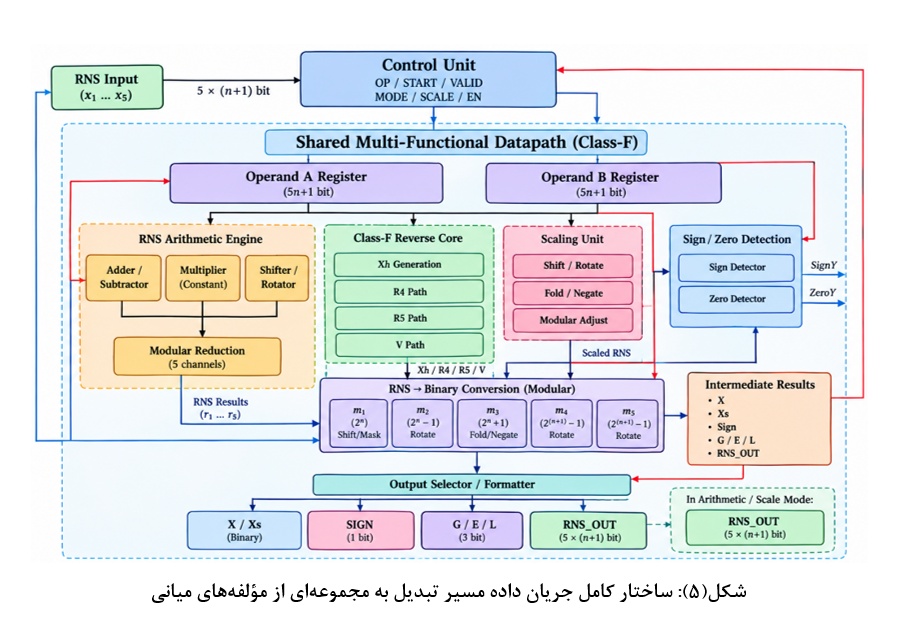
The residue number system (RNS), by eliminating carry propagation among moduli, enables fast and parallel computation. However, inter-modular operations such as reverse conversion, sign detection, number comparison, and scaling can become major bottlenecks in RNS-based architectures. In this study, a novel multifunctional unit is designed and evaluated for a Class-F five-moduli set with the aim of reducing hardware redundancy and improving the efficiency of inter-modular computations. The employed moduli set is , and the proposed architecture supports modular arithmetic operations, including addition, subtraction, and multiplication, together with reverse conversion, sign detection, signed-number comparison, and scaling within an integrated structure. In the proposed approach, the reverse-conversion core is designed using a staged architecture and the computation of intermediate information, while part of the same hardware resources is reused for sign detection and other inter-modular operations. Furthermore, hardware resource sharing, critical-path reduction, and optimization of the computational structure are employed to control circuit redundancy. The architecture was implemented at the register-transfer level (RTL) and, following functional validation, synthesized using 65-nm CMOS technology and evaluated in terms of area, critical-path delay, and area-delay product (ADP). The results for (n=8), (12), and (26), corresponding to dynamic ranges of approximately 40, 60, and 130 bits, respectively, show that the proposed unit achieves areas of 5,592.9, 9,594.3, and 19,836.9 µm² and critical-path delays of 0.397, 0.439, and 0.526 ns, respectively. The corresponding ADP values are 2,220.3813, 4,211.8977, and 10,434.2094 µm²·ns. The results demonstrate the favorable efficiency of the proposed architecture and the effectiveness of hardware resource sharing in the design of a multifunctional unit for a Class-F five-moduli residue number system.
References
[1] Ahsan, J., et al. (2022). Efficient FPGA implementation of RNS Montgomery multipliers. VLSI Journal / ACM.
[2] Akkal, M. (2007). A new Mixed Radix Conversion algorithm MRC-II. Computers & Mathematics with Applications.
[3] Alsuhli, G. (2023). Number Systems for Deep Neural Network Architectures. arXiv.
[4] Alvani, D. (2024). Fast And Area-Efficient Reverse Converters For Five ModuliSet {2n+ 1, 2n-1-1, 2n, 2n+ 11, 2n-1}. Educational Administration: Theory and Practice, 30(5), 2385-2400.
[5] Chakraborti, N. B., & Sinha, S. (1986). An implementation of mixed-radix conversion for residue number systems. IEEE Transactions on Computers.
[6] Cao, B., Chang, C. H., & Srikanthan, T. (2007). A residue-to-binary converter for a new five-moduli set. IEEE Transactions on Circuits and Systems I: Regular Papers, 54(5), 1041-1049.
[7] Garner, H. (1959). The residue number system. IRE Transactions on Electronic Computers, EC-8(2), 140–147.
[8] Jaberipur, G., et al. (2014). A ROM-less reverse RNS converter for moduli set {2^q ± 1, 2^q, …}. IET Computers & Digital Techniques.
[9] Kuchukov, V. (2022). Performance analysis of hardware implementations of RNS reverse conversion methods. Applied Sciences, 12(23), 12355.
[10] Menezes, A., van Oorschot, P., & Vanstone, S. (1997). Handbook of applied cryptography. CRC Press.
[11] Ming, X., Hu, S., & He, S. (2011). High-performance residue number system for digital signal processing. IEEE Transactions on Signal Processing, 59(9), 3771–3782.
[12] Molahosseini, A. S., Emrani Zarandi, A. A., Martins, P., & Sousa, L. (2017). A multifunctional unit for designing efficient RNS-based datapaths. IEEE Access, 5, 25972–25983.
[13] Nature / Research Intelligence. Residue number system architectures & applications (overview). Nature.
[14] Nguyen, T. (2013). Fast modular exponentiation using residue domain (Shenoy–Kumaresan). University report.
[15] Niras, C. V., & Kong, Y. (2016). Fast sign‐detection algorithm for residue number system moduli set {2n− 1, 2n, 2n+ 1− 1}. IET Computers & Digital Techniques, 10(2), 54-58.
[16] Omondi, A., & Premkumar, B. (2007). Residue number systems: Theory and applications. Imperial College Press.
[17] Parhami, B. (2000). Computer arithmetic: Algorithms and hardware designs. Oxford University Press.
[18] Patronik, P., & Piestrak, S. J. (2017). Design of Reverse Converters for a New Flexible RNS Five-Moduli Set {2 k, 2 n-1, 2 n+ 1, 2 n+ 1-1, 2 n-1-1}(n Even). Circuits, Systems, and Signal Processing, 36(11), 4593-4614.
[19] Salamat, S., et al. (2021). Residue-Net: Multiplication-free neural network by in-situ RNS. ResidueNet Project, UCSD.
[20] Shenoy, A. P., & Kumaresan, R. (1989). Fast base extension using a redundant modulus in RNS. IEEE Transactions on Computers, 38(2), 292–297.
[21] Szabo, N. S., & Tanaka, R. I. (1967). Residue arithmetic and its applications to computer technology. McGraw-Hill.
[22] Various review articles (2020–2022). RNS reverse converters and base extension. IJSTR (2020); MDPI Applied Sciences (2022).
[23] Wang, Y. (1984). Residue number system arithmetic: Modern applications in digital signal processing. IEEE Transactions on Acoustics, Speech, and Signal Processing, 32(2), 152–160.
[24] Mojahed, M., Molahosseini, A. S., & Zarandi, A. A. E. (2021). Multifunctional unit for reverse conversion and sign detection based on five-moduli set {22n, 2 n+ 1, 2 n− 1, 2 n+ 3, 2 n− 3}. Computer Science, 22, 101-121.
[25] Kumar, S., & Chang, C. H. (2017). A Scaling-Assisted Signed Integer Comparator for the Balanced Five-Moduli Set RNS ${2^{n}-1, 2^{n}, 2^{n}+ 1, 2^{n+ 1}-1, 2^{n-1}-1} $. IEEE Transactions on Very Large Scale Integration (VLSI) Systems, 25(12), 3521-3533.
Downloads
Publication Timeline
- Submitted
- Revised
- Accepted
Issue
Section
License
Copyright (c) 2025 ﻣﺤﻤﺪﺣﺴﯿﻦ اعظمی راد (نویسنده); اﻣﯿﺮ ﺻﺒﺎغ ﻣﻼحسینی (نویسنده مسئول); آزاده اﻟﺴﺎدات عمرانی زرﻧﺪي, پیمان کشاورزیان (نویسنده)

This work is licensed under a Creative Commons Attribution-NonCommercial 4.0 International License.