Target Setting in Production Technologies with Multiple Component Processes
Keywords:
Pareto-efficient, convexity, projection point, closest targetAbstract
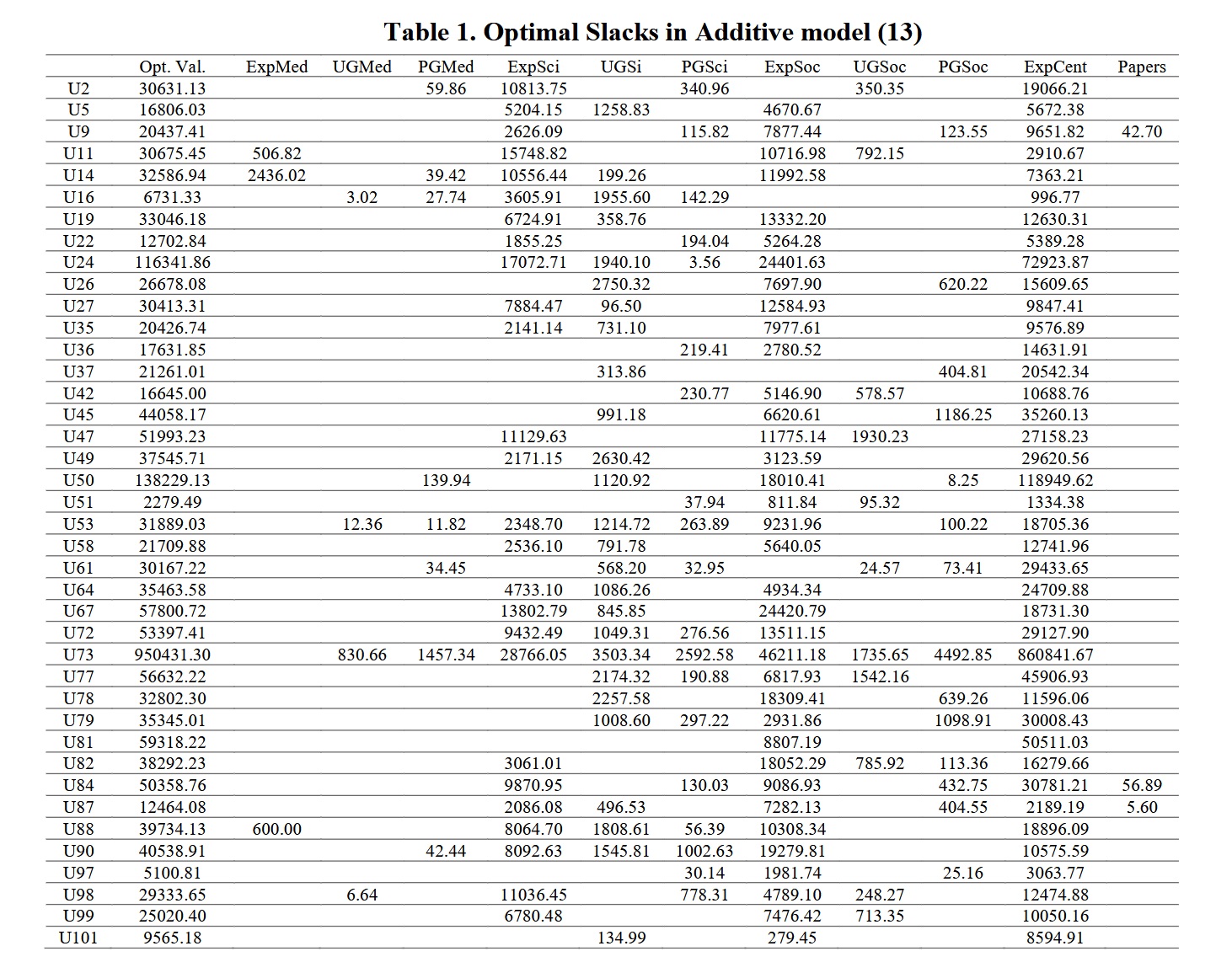
In this paper, we consider non-parametric production technologies with multiple component production processes, where each component uses both specific and shared inputs to produce specific and shared outputs. Investigating the issue of target setting within these technologies, we show that how efficient benchmarks for in-efficient units within the multi-component production technologies can be obtained by using basic envelopment and multiplier Data Envelopment Analysis models. Furthermore, we formulate efficient frontier of multi-component technology and develop a mixed integer optimization model that obtains closest targets for each in-efficient activity. The proposed models are finally illustrated on a real data set consisting 102 public universities in the UK.
References
Aparicio, J., & Monge, J. F. (2022). The generalized range adjusted measure in data envelopment analysis: properties, computational aspects and duality. European Journal of Operational Research, 302(2), 621-632.
Aparicio, J., Ruiz, J. L., & Sirvent, I. (2007). Closest targets and minimum distance to the Pareto-efficient frontier in DEA. Journal of productivity analysis, 28(3), 209-218.
Beasley, J. E. (1995). Determining teaching and research efficiencies. Journal of the operational research society, 46(4), 441-452.
Charnes, A., Cooper, W. W., & Rhodes, E. (1978). Measuring the efficiency of decision making units. European journal of operational research, 2(6), 429-444.
Cherchye, L., De Rock, B., & Walheer, B. (2016). Multi-output profit efficiency and directional distance functions. Omega, 61, 100-109.
Cherchye, L., Rock, B. D., Dierynck, B., Roodhooft, F., & Sabbe, J. (2013). Opening the “black box” of efficiency measurement: Input allocation in multioutput settings. Operations Research, 61(5), 1148-1165.
Cook, W. D., & Green, R. H. (2004). Multicomponent efficiency measurement and core business identification in multiplant firms: A DEA model. European Journal of Operational Research, 157(3), 540-551.
Cook, W. D., & Hababou, M. (2001). Sale performance measurement in bank branches. Omega 29(4), 299-307.
Cook, W. D., Hababou, M., & Tuenter, H. J. (2000). Multicomponent efficiency measurement and shared inputs in data envelopment analysis: an application to sales and service performance in bank branches. Journal of productivity Analysis, 14(3), 209-224.
Cook, W. D., & Zhu, J. (2006). Incorporating multi-process performance standards into the DEA framework. Operations Research, 54(4), 656-665.
Cook, W. D., & Zhu, J. (2011). Multiple variable proportionality in data envelopment analysis. Operations Research, 59(4), 1024-1032.
Cook, W. D., Ruiz, J. L., Sirvent, I., & Zhu, J. (2017). Within-group common benchmarking using DEA. European Journal of Operational Research, 256(3), 901-910.
Dehnokhalaji, A., & Soltani, N. (2019). Gradual efficiency improvement through a sequence of targets. Journal of the Operational Research Society, 70(12), 2143-2152.
Ding, J., Feng, C., Bi, G., Liang, L., & Khan, M. R. (2015). Cone ratio models with shared resources and nontransparent allocation parameters in network DEA. Journal of Productivity Analysis, 44(2), 137-155.
Ghahraman, A., & Prior, D. (2016). A learning ladder toward efficiency: Proposing network-based stepwise benchmark selection. Omega, 63, 83-93.
Guevel, H. P., Ramón, N., & Aparicio, J. (2025). Benchmarking in data envelopment analysis: Balanced efforts to achieve realistic targets. Annals of Operations Research, 351(2), 1403-1426.
Farrell, M. J. (1957). The measurement of productive efficiency. Journal of the royal statistical society series a: statistics in society, 120(3), 253-281.
Kao, C. (2014). Network data envelopment analysis: A review. European Journal of Operational research, 239(1), 1-16.
Lozano, S., & Villa, G. (2005). Determining a sequence of targets in DEA. Journal of the Operational Research Society, 56(12), 1439-1447.
Lozano, S., & Villa, G. (2010). Gradual technical and scale efficiency improvement in DEA. Annals of Operations Research, 173(1), 123-136.
Lozano, S., & Calzada-Infante, L. (2018). Computing gradient-based stepwise benchmarking paths. Omega, 81, 195-207.
Monge, J. F., & Ruiz, J. L. (2023). Setting closer targets based on non-dominated convex combinations of Pareto-efficient units: A bi-level linear programming approach in Data Envelopment Analysis. European Journal of Operational Research, 311(3), 1084-1096.
Nasrabadi, N. (2019). A sequence of targets toward a common best practice frontier in DEA. Journal of Industrial Engineering International, 15(4), 695-707.
Nasrabadi, N., Dehnokhalaji, A., Korhonen, P., & Wallenius, J. (2019). A stepwise benchmarking approach to DEA with interval scale data. Journal of the Operational Research Society, 70(6), 954-961.
Olesen, O. B., Petersen, N. C., & Podinovski, V. V. (2022). Scale characteristics of variable returns-to-scale production technologies with ratio inputs and outputs. Annals of Operations Research. 318(1), 383-423.
Papaioannou, G., & Podinovski, V. V. (2023). Multicomponent production technologies with restricted allocations of shared inputs and outputs. European Journal of Operational Research, 308(1), 274-289.
Papaioannou, G., & Podinovski, V. V. (2025). Free disposal hull models of multicomponent technologies. Annals of Operations Research, 351(2), 1559-1587.
Podinovski, V. V. (2022). Variable and constant returns-to-scale production technologies with component processes. Operations Research, 70(2), 1238-1258.
Podinovski, V. V., Olesen, O. B., & Sarrico, C. S. (2018). Nonparametric production technologies with multiple component processes. Operations Research, 66(1), 282-300.
Ramón, N., Ruiz, J. L., & Sirvent, I. (2018). Two-step benchmarking: Setting more realistically achievable targets in DEA. Expert Systems with Applications, 92, 124-131.
Rostamzadeh, R., Akbarian, O., Banaitis, A., & Soltani, Z. (2021). Application of DEA in benchmarking: a systematic literature review from 2003–2020. Technological and Economic Development of Economy, 27(1), 175-222.
Ruiz, J. L., Segura, J. V., & Sirvent, I. (2015). Benchmarking and target setting with expert preferences: An application to the evaluation of educational performance of Spanish universities. European Journal of Operational Research, 242(2), 594-605.
Ruiz, J. L., & Sirvent, I. (2016). Common benchmarking and ranking of units with DEA. Omega, 65, 1-9.
Soltani, N., & Lozano, S. (2020). Interactive multiobjective DEA target setting using lexicographic DDF. RAIRO-Operations Research, 54(6), 1703-1722.
Walheer, B. (2018). Disaggregation of the cost Malmquist productivity index with joint and output-specific inputs. Omega, 75, 1-12.
Zhu, Q., Aparicio, J., Li, F., Wu, J., & Kou, G. (2022). Determining closest targets on the extended facet production possibility set in data envelopment analysis: modeling and computational aspects. European Journal of Operational Research, 296(3), 927-939.
Downloads
Publication Timeline
- Submitted
- Revised
- Accepted
Issue
Section
License
Copyright (c) 2025 نسیم نصرآبادی (نویسنده)

This work is licensed under a Creative Commons Attribution-NonCommercial 4.0 International License.