Presenting a Dynamic Capabilities-Based Model of Petroleum Products Logistics Management
Keywords:
Logistics management, Dynamic capabilities, Petroleum products, Fuzzy DEMATELAbstract
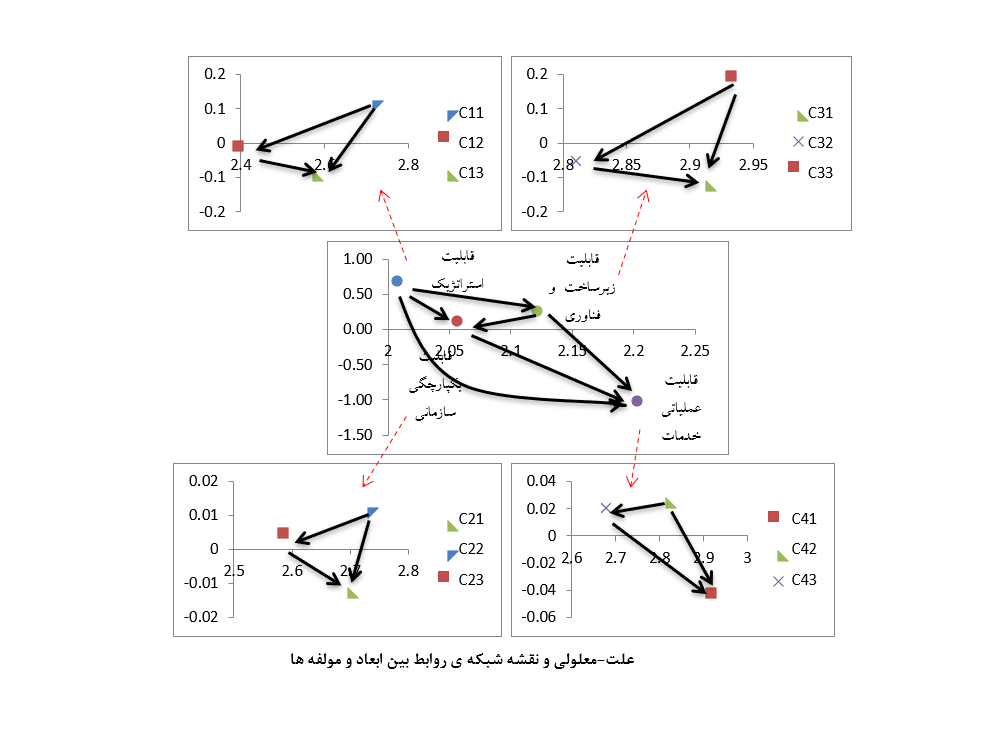
The logistics management of strategic petroleum products is essential for providing timely and appropriate services. Accordingly, the present study aimed to present a dynamic capabilities-based model of petroleum products logistics management using a qualitative–quantitative approach. The research method was multiple content analysis (deductive and inductive) in the qualitative section and causal in the quantitative section. The statistical population of the study consisted of participants including managers and senior experts in the logistics sector of the National Iranian Oil Products Distribution Company, among whom 21 individuals were selected through purposive non-probability sampling. Data were collected through semi-structured interviews in the qualitative section and a questionnaire in the quantitative section. The qualitative findings showed that the model consists of four dimensions: “strategic capability,” “organizational integration capability,” “infrastructure and technology capability,” and “service operational capability.” These dimensions were confirmed using the fuzzy Delphi method. The causal relationship findings obtained through fuzzy DEMATEL indicated that “strategic capability,” “infrastructure and technology capability,” and “organizational integration capability” are causal factors, while “service operational capability” is an effect factor and receives the greatest influence. The components of “transportation management,” “service organization,” “order management,” “data and information management,” and “advanced technology” had the highest weight and importance. These findings highlight the importance of collaborative transportation scheduling and planning, procurement planning, and timely responsiveness to customer requests, indicating that managers can achieve superior logistics objectives by focusing on capabilities, facilities, and technological infrastructures.
References
Abou Kamar, M., Albadry, O. M., Sheikhelsouk, S., Ali Al-Abyadh, M. H., & Alsetoohy, O. (2023). Dynamic capabilities influence on the operational performance of hotel food supply chains: A mediation-moderation model. Sustainability, 15(18), 13562.
Ayompe, L. M., Schaafsma, M., & Egoh, B. N. (2021). Towards sustainable palm oil production: The positive and negative impacts on ecosystem services and human wellbeing. Journal of Cleaner Production, 278, 123914.
Bahraloloom, S. H., Abbas Pour Esfadan, G., Fathi Hafshejani, K., & Modiri, M. (2025). Presenting a performance evaluation model for logistics service companies of the Ministry of Petroleum using an integrated data envelopment analysis and Markowitz method approach. Management, Education and Development in the Digital Age, 2(1), 13–28.
Bosire, C., Kising’u, T. M., & Gichinga, L. W. (2025). Dynamic capabilities and performance of logistics companies in Mombasa County, Kenya. Reviewed Journal International of Business Management, 6(1), 341–365.
Chari, A., Niedenzu, D., Despeisse, M., Machado, C. G., Azevedo, J. D., Boavida-Dias, R., & Johansson, B. (2022). Dynamic capabilities for circular manufacturing supply chains: Exploring the role of Industry 4.0 and resilience. Business Strategy and the Environment, 31(5), 2500–2517.
Chofreh, A. G., Goni, F. A., Yu, Z., Wang, B., Afzal, M., Darvazeh, S. S., & Hajiaghaei-Keshteli, M. (2025). Identifying and prioritising sustainability integration strategies in oil industry logistics: A multi-dimensional analysis. Research in Transportation Business & Management, 63, 101495.
Dobrovnik, M., Herold, D. M., & Kummer, S. (2025). Exploring supply chain managers’ complex perceptions of dynamic capabilities for digital transformation. Digital Business, 5(1), 100098.
Dovbischuk, I. (2022). Innovation-oriented dynamic capabilities of logistics service providers, dynamic resilience and firm performance during the COVID-19 pandemic. The International Journal of Logistics Management, 33(2), 499–519.
Fan, P., & Liu, Z. (2025). Formation mechanisms of dynamic capabilities based on relational capital of enterprises in emerging economies under institutional change: A multiple case study in the context of China’s reform and opening-up. Asian Journal of Technology Innovation, 33(2), 688–731.
Febriani, A., Sopha, B. M., & Wibisono, M. A. (2025). Dynamic capabilities for omnichannel transformation in MSMEs: A comparative case study of fashion and furniture sectors. Journal of Open Innovation: Technology, Market, and Complexity, 11(1), 100498.
Ferrazzi, M., Costa, F., Frecassetti, S., & Portioli-Staudacher, A. (2025). Unlocking synergies in lean manufacturing for enhanced environmental performance: A cross-sector investigation through fuzzy DEMATEL. Cleaner Logistics and Supply Chain, 100219.
Hasan, M. K., Lei, X., Hlali, A., & Bian, Z. (2024). Modelling capability factors of logistics industry based on ISM-MICMAC. Heliyon, 10(22), 30–56.
Ju, K. J., Park, B., & Kim, T. (2016). Causal relationship between supply chain dynamic capabilities, technological innovation, and operational performance. Management and Production Engineering Review, 7.
Loska, D., Hazen, B., Rich, N., Genchev, S., & Malik, T. (2025). Military supply chain logistics and dynamic capabilities: A literature review and synthesis. Transportation Journal, 64(2), e70002.
Malik, R. S., Srivastava, M. K., & Shaikh, I. (2021). Modeling enablers of transporter’s performance in downstream logistics of the Indian oil sector. Advances in Operations Research, 2021, 1–22.
Mhaibes, H. A. (2018). An analytical study of the strategic flexibility variation as a function of the dynamic capabilities based on supply chain management: Case study: The General Petroleum Products Distribution Company in Baghdad. International Journal of Supply Chain Management, 7(5), 667–683.
Modiri, M., Shiramin, M. D., & Karimi Shirazi, H. (2019). Identification and prioritization of influencing factors on safety performance with hybrid fuzzy DEMATEL and analytical network process approach (DANP): Case study: A combined cycle power plant. Journal of Health & Safety at Work, 9(1), 49–60.
Mousavi, S., & Bossink, B. (2020). Corporate-NGO partnership for environmentally sustainable innovation: Lessons from a cross-sector collaboration in aviation biofuels. Environmental Innovation and Societal Transitions, 34, 80–95.
Mwangangi, P. W. (2016). Influence of logistics management on performance of manufacturing firms in Kenya [Doctoral dissertation, Jomo Kenyatta University of Agriculture and Technology].
Okitte, S. O., Bonuke, R., & Stanley Kavale, S. (2024). Logistics infrastructure and supply efficiency of petroleum products in Kenya: A survey of oil marketing companies in Kenya. The Strategic Journal of Business & Change Management, 11(1), 9–22.
Özcan, S., Oflaç, B. S., Tokcaer, S., & Özpeynirci, Ö. (2024). Mastering timely deliveries using dynamic capabilities: Perspectives from logistics service providers and shippers. The International Journal of Logistics Management, 35(5), 1653–1677.
Pienaar, W. J. (2010). Logistics management aspects of planning, implementing and controlling commercial petroleum pipeline operations. Corporate Ownership & Control, 8(1), 1–10.
Poi, E. L., Ekwuribe, B., & Ihunwo, E. (2024). Leveraging logistics capabilities for effective supply chain planning of oil and gas firms in South-South Nigeria. International Journal of Social Sciences and Management Research, 10(9), 135–149.
Ponomarov, S. (2012). Antecedents and consequences of supply chain resilience: A dynamic capabilities perspective [Doctoral dissertation, The University of Tennessee].
Popescu, C., & Gabor, M. R. (2021). Quantitative analysis regarding the incidents to the pipelines of petroleum products for an efficient use of the specific transportation infrastructure. Processes, 9(9), 1535.
Provornaya, I. V., Filimonova, I. V., Nemov, V. Y., Komarova, A. V., & Dzyuba, Y. A. (2020). Features of the petroleum products pricing in Russia, in the USA, and Saudi Arabia. Energy Reports, 6, 514–522.
Rahnamay Touhidi, S. R., Taghizadeh, H., & Iranzadeh, S. (2020). Dynamic capability improvement model in the field of international markets in Iranian oil and gas industry. Petroleum Business Review, 4(3), 95–107.
Ramos, E., Patrucco, A. S., & Chavez, M. (2023). Dynamic capabilities in the “new normal”: A study of organizational flexibility, integration and agility in the Peruvian coffee supply chain. Supply Chain Management: An International Journal, 28(1), 55–73.
Sadri, N., Modiri, M., Hafashjani, K. F., & Valmohammadi, C. (2024). Supply chain risk management analysis based on resilience capabilities: Comprehensive structural interpretive modeling approach. Journal of System Management, 10(3).
Sardesai, S., Stute, M., & Kamphues, J. (2021). A methodology for future scenario planning. In Next generation supply chains: A roadmap for research and innovation (pp. 35–59). Springer International Publishing.
Seddaoui, R., & Larabi, C. (2025). Strategic decision-making in SMEs: Examining the influence of marketing managers’ capabilities on firm performance in emerging markets through mediating and moderating mechanisms. EuroMed Journal of Business, 1–35.
Seifert, R. (2015). Dynamic capabilities in sustainable supply chain management: A theoretical framework. Supply Chain Forum: An International Journal, 16(4), 2–15.
Semke, L. M., & Tiberius, V. (2020). Corporate foresight and dynamic capabilities: An exploratory study. Forecasting, 2(2), 180–193.
Stadler, C., Helfat, C. E., & Verona, G. (2013). The impact of dynamic capabilities on resource access and development. Organization Science, 24(6), 1782–1804.
Sunagatullin, R., Timofeev, F., Kuznetsov, A., & Oludina, Y. (2019). Relevant issues on quality evaluation of petroleum pipeline preparation for oil product transportation. Oil & Gas Science and Technology–Revue d’IFP Energies Nouvelles, 74, 44.
Wang, S., Wang, J., & Wang, X. (2024). Risk analysis of human evacuation aboard passenger ships based on fuzzy DEMATEL-ISM-BN. Ocean Engineering, 313, 119520.
Wang, X., & Han, N. (2011). Improvement of oil industry procurement of logistics based on TCO. In 2011 2nd International Conference on Artificial Intelligence, Management Science and Electronic Commerce (AIMSEC) (pp. 1180–1183). IEEE.
Zhao, Z., Meng, F., He, Y., & Gu, Z. (2019). The influence of corporate social responsibility on competitive advantage with multiple mediations from social capital and dynamic capabilities. Sustainability, 11(1), 218.
Downloads
Publication Timeline
- Submitted
- Revised
- Accepted
Issue
Section
License
Copyright (c) 2025 حسین نیازی, بهرام علیشیری, محمود مدیری (نویسنده)

This work is licensed under a Creative Commons Attribution-NonCommercial 4.0 International License.