ارزیابی عوامل موثر بر پذیرش زنجیره تأمین پایدار و تابآور در کسب و کارهای کوچک و متوسط (SMEs) ایران
کلمات کلیدی:
زنجیره تأمین پایدار, تابآوری زنجیره تأمین, بنگاههای کوچک و متوسط, دلفی فازی, بهترین-بدترین فازیچکیده
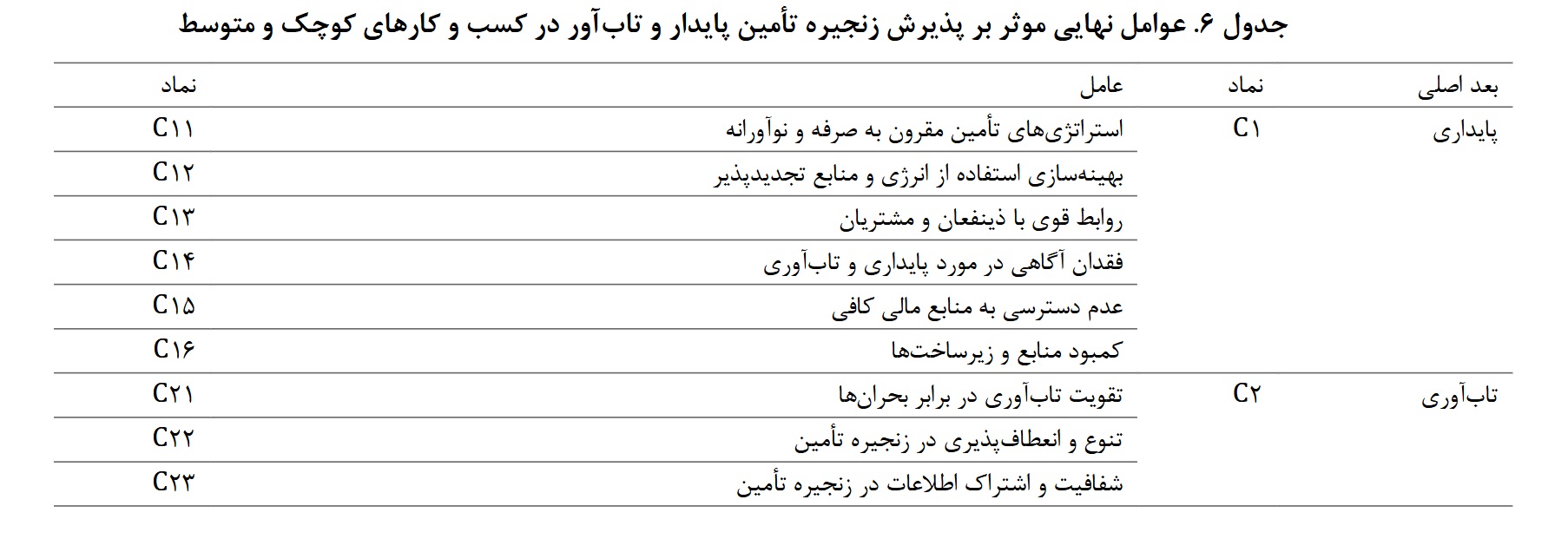
این پژوهش با هدف شناسایی و اولویتبندی عوامل مؤثر بر پذیرش زنجیره تأمین پایدار و تابآور در بنگاههای کوچک و متوسط (SMEs) ایران انجام شده است. با توجه به نقش حیاتی این بنگاهها در اشتغال و تولید ملی و در عین حال آسیبپذیری بالای آنها در برابر بحرانهای اقتصادی و نهادی، ضرورت طراحی چارچوبی بومی برای ارتقای پایداری و تابآوری احساس میشود. در این راستا، ابتدا با مرور نظاممند ادبیات داخلی و بینالمللی، سیزده عامل کلیدی شناسایی گردید که پس از پالایش، به شش عامل پایداری و سه عامل تابآوری طبقهبندی شدند. سپس بهمنظور اعتبارسنجی و وزندهی عوامل، از روش دلفی فازی برای غربالسازی معیارها و از روش بهترین-بدترین فازی جهت محاسبه وزنهای نهایی استفاده شد. یافتهها نشان داد که تابآوری اهمیت بیشتری نسبت به پایداری در SMEs ایران دارد و در میان عوامل، تقویت تابآوری در برابر بحرانها، تنوع و انعطافپذیری در زنجیره تأمین و شفافیت و اشتراک اطلاعات در رتبههای نخست قرار گرفتند. این نتایج بیانگر فضای پرریسک و ناپایدار اقتصادی ایران است که در آن بقا و بازیابی سریع بنگاهها بر ملاحظات زیستمحیطی و اقتصادی تقدم مییابد. از منظر کاربردی، سیاستگذاران و مدیران باید با توسعه شبکههای همکاری، استقرار سیستمهای دیجیتال شفافساز، حمایت از فناوریهای سبز و ایجاد مشوقهای مالی و فناورانه، مسیر حرکت بنگاهها به سوی زنجیرههای مقاوم و پایدار را هموار سازند.
مراجع
Abudu, R., Thompson, E. A., Dzawu, F. S., & Roa-Henriquez, A. (2025). A meta-analysis assessment of adaptive and transformative approaches to supply chain resilience. Supply Chain Analytics, 10, 100124. https://doi.org/https://doi.org/10.1016/j.sca.2025.100124
Afaneh, J. A. A., & Bello, Z. (2023). Advancing supply chain sustainability in SMEs through strategic capabilities: the roles of supply chain resilience and mapping. International Journal of Construction Supply Chain Management, 13(1), 134–153.
Alam, C. M., Setiawan, B., Toiba, H., Maulidah, S., & Rahman, S. M. (2025). Supply chain management practices of SMEs in developing countries: Bibliometric and systematic reviews. Agricultural Economics, 71(2), 99–112. https://agricecon.agriculturejournals.cz/artkey/age-202502-0004.php
Aleali, H. (2024). The small and medium-sized Iranian enterprises’ challenges and concerns for benefiting from standards (A case study in industrial towns and technology parks in Tehran and Alborz provinces). Advances in the Standards & Applied Sciences, 2(1), 19–24.
Alshahrani, M. A., & Salam, M. A. (2022). The Role of supply chain resilience on SMEs’ performance: The case of an emerging economy. Logistics, 6(3), 47.
Bak, O., Shaw, S., Colicchia, C., & Kumar, V. (2020). A systematic literature review of supply chain resilience in small–medium enterprises (SMEs): A call for further research. IEEE Transactions on Engineering Management, 70(1), 328–341.
Baral, M. M., Singh, R. K., & Kazançoğlu, Y. (2021). Analysis of factors impacting survivability of sustainable supply chain during COVID-19 pandemic: an empirical study in the context of SMEs. The International Journal of Logistics Management, 34(4), 935–961. https://doi.org/10.1108/IJLM-04-2021-0198
Bayatzadeh, S., & Talaie, H. (2025). Identifying and evaluating criteria for selecting sustainable and resilient suppliers (Case study: Wooden furniture and decoration industry. Iranian Journal of Wood and Paper Science Research, 40(1), 1-19. (in Persian).
Canwat, V. (2024). COVID-19-related supply chain disruptions: resilience and vulnerability of micro, small and medium enterprises. Cogent Business & Management, 11(1), 2315691.
Carissimi, M. C., Bin Hameed, H., & Creazza, A. (2024). Circular economy: The future nexus for sustainable and resilient supply chains? Sustainable Futures, 8, 100365. https://doi.org/https://doi.org/10.1016/j.sftr.2024.100365
Çeli̇k, A. K., Yildiz, T., Aykanat, Z., & Kazemzadeh, S. (2025). Green Innovation Adoption in Turkish and Iranian SMEs: The Effect of Dynamic Capabilities and the Mediating Role of Absorptive Capacity. Journal of the Knowledge Economy, 16(1), 1824–1859. https://doi.org/10.1007/s13132-024-01990-1
Chen, Y., Wang, Z., Zhuang, Y., & Tang, H. (2021). Analysis and design of sigma-delta ADCs for automotive control systems. 2021 IEEE 3rd International Conference on Circuits and Systems (ICCS), 235–241.
Chowdhury, M. M. H., Chowdhury, P., Quaddus, M., Rahman, K. W., & Shahriar, S. (2024). Flexibility in Enhancing Supply Chain Resilience: Developing a Resilience Capability Portfolio in the Event of Severe Disruption. Global Journal of Flexible Systems Management, 25(2), 395–417. https://doi.org/10.1007/s40171-024-00391-2
Córdova-Aguirre, L. J., & Ramón-Jerónimo, J. M. (2024). Designing a sustainability assessment framework for Peruvian manufacturing small and medium enterprises applying the stakeholder theory approach. Sustainability, 16(5), 1853.
Danacı, M., & Yıldırım, U. (2023). Comprehensive analysis of lifeboat accidents using the Fuzzy Delphi method. Ocean Engineering, 278, 114371.
Doetsch, S., & Huchzermeier, A. (2024). The intersection of supply chain resilience and sustainability from a theoretical and practical perspective: An integrated framework. Journal of Cleaner Production, 484, 144306. https://doi.org/https://doi.org/10.1016/j.jclepro.2024.144306
Ebrahimpour,M. , Moradi,M. and Fallahpour,A. (2023). The impact of supply chain dynamics on the firm sustainable performance with remanufacturing capability and supply chain resilience. Journal of Strategic Management Studies, 14(54), 97-117. (in Persian).
Faggioni, F., Rossi, M. V., & Sestino, A. (2024). Conceptualizing Supply Chain Resilience in Exogenous Crisis Times: Toward a Holistic Definition. Journal of the Knowledge Economy, 15(4), 17308–17332. https://doi.org/10.1007/s13132-024-01816-0
Gonçalves, H., Magalhães, V. S. M., Ferreira, L. M. D. F., & Arantes, A. (2024). Overcoming barriers to sustainable supply chain management in small and medium-sized enterprises: a multi-criteria decision-making approach. Sustainability, 16(2), 506.
Guo, S., & Zhao, H. (2017). Fuzzy best-worst multi-criteria decision-making method and its applications. Knowledge-Based Systems, 121, 23–31.
Hosseini Shekarabi, S. A., Kiani Mavi, R., & Romero Macau, F. (2025). Supply Chain Resilience: A Critical Review of Risk Mitigation, Robust Optimisation, and Technological Solutions and Future Research Directions. Global Journal of Flexible Systems Management, 26(3), 681–735. https://doi.org/10.1007/s40171-025-00458-8
Jalali, M., Feng, B., & Feng, J. (2022). An analysis of barriers to sustainable supply chain management implementation: the fuzzy DEMATEL approach. Sustainability, 14(20), 13622.
Joshi, S., & Sharma, M. (2022). Impact of sustainable supply chain management on performance of SMEs amidst COVID-19 pandemic: an Indian perspective. International Journal of Logistics Economics and Globalisation, 9(3), 248–276.
Junejo, I., Sohu, J. M., Alwadi, B. M., Ejaz, F., Nasir, A., & Hossain, M. B. (2025). Green supply chain management and SMEs sustainable performance in developing country: role of green knowledge sharing, green innovation and big data-driven supply chain. Discover Sustainability, 6(1), 342. https://doi.org/10.1007/s43621-025-01055-6
Kanyepe, J., Musasa, T., & Wilbert, M. (2025). Supply chain risk factors, technological capabilities, and firm performance of small to medium enterprises (SMEs). Journal of Small Business Strategy, 35(1), 115–128.
Karmaker, C. L., Aziz, R. Al, Palit, T., & Bari, A. B. M. M. (2023). Analyzing supply chain risk factors in the small and medium enterprises under fuzzy environment: Implications towards sustainability for emerging economies. Sustainable Technology and Entrepreneurship, 2(1), 100032. https://doi.org/https://doi.org/10.1016/j.stae.2022.100032
Kayani, S. A., & Warsi, S. S. (2025). Exploring the synergy between sustainability and resilience in supply chains under stochastic demand conditions and network disruptions. Results in Engineering, 26, 104954. https://doi.org/https://doi.org/10.1016/j.rineng.2025.104954
Khorshidikia, S., Rismanchian, M., & Habibi, E. (2025). A narrative review on the application of Delphi and fuzzy Delphi techniques in the cement industry. Work, 80(4), 1507–1517.
Kosasih, W., Pujawan, I. N., & Karningsih, P. D. (2023). Integrated lean-green practices and supply chain sustainability for manufacturing SMEs: a systematic literature review and research agenda. Sustainability, 15(16), 12192.
Kumar, A., Shrivastav, S. K., Shrivastava, A. K., Panigrahi, R. R., Mardani, A., & Cavallaro, F. (2023). Sustainable supply chain management, performance measurement, and management: a review. Sustainability, 15(6), 5290.
Li, W., & Liu, Z. (2023). Social, environmental, and governance factors on supply-chain performance with mediating technology adoption. Sustainability, 15(14), 10865.
Mahmud, P., Paul, S. K., Azeem, A., & Chowdhury, P. (2021). Evaluating supply chain collaboration barriers in small-and medium-sized enterprises. Sustainability, 13(13), 7449.
Mishra, R., & Singh, R. K. (2023). A systematic literature review on supply chain resilience in SMEs: learnings from COVID-19 pandemic. International Journal of Quality & Reliability Management, 40(5), 1172–1202.
Mwenda, B., Israel, B., & Mahuwi, L. (2023). The influence of sustainable supply chain management practices on financial sustainability of food processing SMEs. LBS Journal of Management & Research, 21(2), 218–235.
Naghipour, M. S., Rahim, Z. A., & Iqbal, M. S. (2024). A 5G competency model based on the fuzzy Delphi method. Journal of Infrastructure, Policy and Development, 8(10), 6788.
Negri, M., Cagno, E., Colicchia, C., & Sarkis, J. (2021). Integrating sustainability and resilience in the supply chain: A systematic literature review and a research agenda. Business Strategy and the Environment, 30(7), 2858–2886. https://doi.org/https://doi.org/10.1002/bse.2776
Nguyen Thi, M. A., & Vu Dinh, K. (2025). Social capital and sustainable performance: examining the mediating role of supply chain resilience in an emerging economy. Discover Sustainability, 6(1), 764. https://doi.org/10.1007/s43621-025-01692-x
Okeke, A. (2024). Evaluating sustainable practices and supply chain management effectiveness in African small and medium-sized enterprises (SMEs). Journal of Sustainability Research, 6(2), e240033.
Primadasa, R., Kusrini, E., Mansur, A., & Masudin, I. (2025). Enhancing SME supply chain sustainability through organizational ambidexterity and supply chain agility using the MOORA-ISM-MICMAC framework. Sustainable Futures, 10, 101373. https://doi.org/https://doi.org/10.1016/j.sftr.2025.101373
Rejeb, A., Rejeb, K., Keogh, J. G., & Zailani, S. (2022). Barriers to blockchain adoption in the circular economy: a fuzzy Delphi and best-worst approach. Sustainability, 14(6), 3611.
Rezaei, J. (2015). Best-worst multi-criteria decision-making method. Omega, 53, 49–57.
Rezaei, J. (2016). Best-worst multi-criteria decision-making method: Some properties and a linear model. Omega, 64, 126–130.
Schifano, J., & Niederberger, M. (2025). How Delphi studies in the health sciences find consensus: a scoping review. Systematic Reviews, 14(1), 14.
Setyadi, A., Pawirosumarto, S., & Damaris, A. (2025). Toward a Resilient and Sustainable Supply Chain: Operational Responses to Global Disruptions in the Post-COVID-19 Era. Sustainability, 17(13), 6167.
Setyaningsih, S., Widjojo, R., & Kelle, P. (2024). Challenges and opportunities in sustainability reporting: a focus on small and medium enterprises (SMEs). Cogent Business & Management, 11(1), 2298215.
Shan, H., Bai, D., Fan, X., Shi, J., Li, Y., & Yang, S. (2023). Enabling roles of integration and resilience for sustainable supply Chain performance: an empirical study on China’s E-commerce platforms. Applied Economics, 55(60), 7079–7093. https://doi.org/10.1080/00036846.2023.2186354
Soni, G., Kumar, S., Mahto, R. V, Mangla, S. K., Mittal, M. L., & Lim, W. M. (2022). A decision-making framework for Industry 4.0 technology implementation: The case of FinTech and sustainable supply chain finance for SMEs. Technological Forecasting and Social Change, 180, 121686.
Sun, J., Sarfraz, M., Khawaja, K. F., & Abdullah, M. I. (2022). Sustainable Supply Chain Strategy and Sustainable Competitive Advantage: A Mediated and Moderated Model. Frontiers in Public Health, Volume 10-2022. https://www.frontiersin.org/journals/public-health/articles/10.3389/fpubh.2022.895482
Tahmasebi, H., & Mahsa, M. (2019). Analysis of resilience and sustainability criteria in the pharmaceutical supply chain using the interpretive structural modeling (ISM) method. Standard and Quality Management Quarterly, 9(Winter), 40–48. (in Persian).
Tsai, H.-C., Lee, A.-S., Lee, H.-N., Chen, C.-N., & Liu, Y.-C. (2020). An application of the fuzzy Delphi method and fuzzy AHP on the discussion of training indicators for the regional competition, Taiwan national skills competition, in the trade of joinery. Sustainability, 12(10), 4290.
Tukamuhabwa, B. R., Stevenson, M., Busby, J., & Zorzini, M. (2015). Supply chain resilience: definition, review and theoretical foundations for further study. International Journal of Production Research, 53(18), 5592–5623. https://doi.org/10.1080/00207543.2015.1037934
Warmbier, P., Kinra, A., & Ivanov, D. (2022). Supply Chain Sustainability and Resilience - Relationship and Congruent Capability Analysis based on Paradox Theory. IFAC-PapersOnLine, 55(10), 311–316. https://doi.org/https://doi.org/10.1016/j.ifacol.2022.09.625
دانلود
گاهشمار انتشار
- ارسال
- بازنگری
- پذیرش
شماره
نوع مقاله
مجوز
حق نشر 2026 متین حیدری رستمی (نویسنده); شهاب بیات زاده (نویسنده مسئول)

این پروژه تحت مجوز بین المللی Creative Commons Attribution-NonCommercial 4.0 می باشد.