Developing a Comprehensive Interpretive-Structural Model for Circular Supply Chain Risks in the Context of Industry 4.0
Keywords:
Risk, Circular Supply Chain, Industry 4.0, Total Interpretive Structural ModelingAbstract
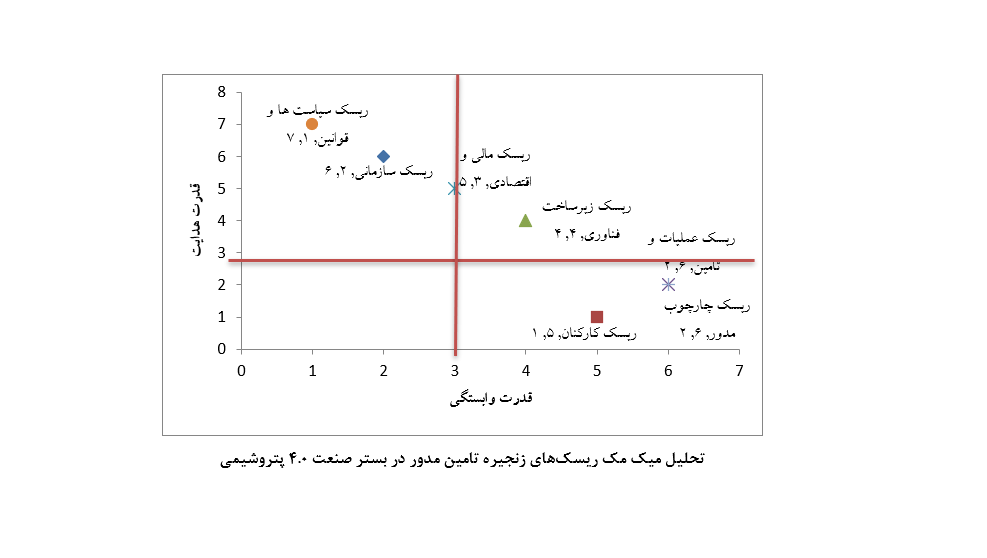
Managing the risks associated with smart technologies in Industry 4.0 within the circular supply chain is important for preventing organizational failure. This study aimed to identify the cause-and-effect relationships among circular supply chain risks in the context of Industry 4.0 in the petrochemical industry using the Total Interpretive Structural Modeling method. The qualitative findings, obtained through content analysis based on a systematic review of the theoretical literature and semi-structured interviews with 18 experts, including senior and middle managers of petrochemical companies, researchers, and university professors, showed that the risks included “organizational risk,” “employee risk,” “technological infrastructure risk,” “circular framework risk,” “financial and economic risk,” “policy and regulatory risk,” and “operations and supply risk.” The causal findings of Total Interpretive Structural Modeling in the quantitative phase indicated that “policy and regulatory risk” was the most influential factor and the main driver of other risks, affecting “organizational risk.” “Financial and economic risk” and “technological infrastructure risk” played mediating roles in the model and had a fundamental role in system complexity. “Circular framework risk,” “employee risk,” and “supply and operations risk” were respectively the most dependent risks and influenced system performance. The results indicate that the lack of governmental support is highly important and influential in creating legal and regulatory risks and disruptions. On the other hand, as supply and operations risk increases, the supply chain shifts from a closed-loop state back to a linear state.
References
Afroozi, A., Humble, M., & Khalili, H. (2024). Barriers and enablers for smart and sustainable circular economy in the automotive industry. Sustainability, 16(2), Article 660. https://doi.org/10.3390/su16020660
Agarwal, N., & Seth, N. (2021). Analysis of supply chain resilience barriers in Indian automotive company using total interpretive structural modelling. Journal of Advances in Management Research, 18(5), 758–781.
Agudo, F. L., Gobbo Júnior, J. A., & Oliveira Gobbo, S. C. (2020). Industry 4.0 and circular economy: Integrated or disarticulated concepts? A research agenda. GEPROS, 15(4), 48–77.
Araújo, I. M. C. N., Gohr, C. F., & Santos, L. C. (2026). Exploring the integration between Industry 4.0 technologies and circular economy practices: A systematic literature review and ISM/MICMAC approach. Circular Economy and Sustainability, 6, Article 135.
Bag, S., Gupta, S., & Kumar, S. (2021). Industry 4.0 adoption and 10R advance manufacturing capabilities for sustainable development. International Journal of Production Economics, 231, Article 107844.
Bakhtari, A. R., Kumar, V., Waris, M. M., Sanin, C., & Szczerbicki, E. (2020). Industry 4.0 implementation challenges in manufacturing industries: An interpretive structural modelling approach. Procedia Computer Science, 176, 2384–2393.
Caiado, R. G. G., Scavarda, L. F., Azevedo, B. D., de Mattos Nascimento, D. L., & Quelhas, O. L. G. (2022). Challenges and benefits of sustainable Industry 4.0 for operations and supply chain management: A framework headed toward the 2030 Agenda. Sustainability, 14(2), Article 830. https://doi.org/10.3390/su14020830
Challouf, K., Alhloul, A., & Nemeth, N. (2025). Mapping the role of Industry 4.0 technologies in green supply chain management: A bibliometric and structured text analysis. Discover Sustainability, 6(1), Article 949.
Charnley, F., Tiwari, D., Hutabarat, W., Moreno, M., Okorie, O., & Tiwari, A. (2019). Simulation to enable a data-driven circular economy. Sustainability, 11(12), Article 3379.
Chauhan, S., Singh, R., Gehlot, A., Akram, S. V., Twala, B., & Priyadarshi, N. (2022). Digitalization of supply chain management with Industry 4.0 enabling technologies: A sustainable perspective. Processes, 11(1), Article 96.
Chhimwal, M., Agrawal, S., & Kumar, G. (2021). Measuring circular supply chain risk: A Bayesian network methodology. Sustainability, 13(15), Article 8448.
Dabbagh, R., Farzan, M., & Mohseni, B. (2025). Identifying the challenges of Industry 4.0 technologies for sustainable operations in small and medium-sized enterprises. Research in Production and Operations Management, 16(1), 1–24.
Das, S. K., Bressanelli, G., & Saccani, N. (2024). Clustering the research at the intersection of Industry 4.0 technologies, environmental sustainability and circular economy: Evidence from literature and future research directions. Circular Economy and Sustainability. Advance online publication. https://doi.org/10.1007/s43615-024-00332-z
Dwivedi, A., & Paul, S. K. (2022). A framework for digital supply chains in the era of circular economy: Implications on environmental sustainability. Business Strategy and the Environment, 31(4), 1249–1274.
El Baz, J., Cherrafi, A., Benabdellah, A. C., Zekhnini, K., Beka Be Nguema, J. N., & Derrouiche, R. (2023). Environmental supply chain risk management for Industry 4.0: A data mining framework and research agenda. Systems, 11(1), Article 46.
Farzadnia, R., Shojaei, P., & Mirghaderi, S. H. (2025). Implementation of circularity in food supply chain based on big data techniques using Einstein’s fuzzy methods. Scientific Reports, 15(1), Article 31957.
Fuchs, D., Kuys, B., Eisenbart, B., & Gericke, K. (2025). A systematic literature review on emerging technology risks in Industry 4.0/5.0: Identification, clustering and developing mitigation strategies. Proceedings of the Design Society, 5, 299–308.
Gebhardt, M., Kopyto, M., Birkel, H., & Hartmann, E. (2022). Industry 4.0 technologies as enablers of collaboration in circular supply chains: A systematic literature review. International Journal of Production Research, 60(23), 6967–6995.
Ghobakhloo, M., Iranmanesh, M., Foroughi, B., Tseng, M.-L., Nikbin, D., & Khanfar, A. (2025). Industry 4.0 digital transformation and opportunities for supply chain resilience: A comprehensive review and a strategic roadmap. Production Planning & Control, 36(1), 61–91.
Giudice, M., Chierici, R., Mazzucchelli, A., & Fiano, F. (2021). Supply chain management in the era of circular economy: The moderating effect of big data. The International Journal of Logistics Management, 32(2), 337–356.
Govardhan, S., Narkhede, B. E., Raut, R., & Ghoshal, G. H. (2025). Industry 4.0 adoption barriers in manufacturing supply chain industry: A case study from a developing economy. International Journal of Computer Integrated Manufacturing, 25(4), 1665–1685.
Heidari, M., Aliakabarnia Omran, M., Modiri, M., & Darvish Motavali, M. H. (2026). Developing a resilient supply chain model based on Industry 4.0 in the circular printing industry. AI and Tech in Behavioral and Social Sciences, 4(1), 1–15.
Hobusch, K., & Misler-Behr, M. (2017). Reduction of supply chain risks due to Industry 4.0 implementation. The EUrASEANs: Journal on Global Socio-Economic Dynamics, 5, 40–47.
Hobusch, K., & Mißler-Behr, M. (2017). Reducing of supply chain risks due to Industry 4.0 implementation. Journal on Global Socio-Economic Dynamics, 5(6), 40–47.
Ismail, K. H., Nikookar, E., Pepper, M., & Stevenson, M. (2025). The implications of Industry 4.0 for managing supply chain disruption and enhancing supply chain resilience: A systematic literature review. International Journal of Production Research, 63(19), 7278–7304.
Ivanov, D., & Dolgui, A. (2021). A digital supply chain twin for managing the disruption risks and resilience in the era of Industry 4.0. Production Planning & Control, 32(9), 775–788.
Kamble, S. S., Gunasekaran, A., Parekh, H., Mani, V., Belhadi, A., & Sharma, R. (2022). Digital twin for sustainable manufacturing supply chains: Current trends, future perspectives, and an implementation framework. Technological Forecasting and Social Change, 176, Article 121448.
Kannan, D., Amiri, A. S., Shaayesteh, M. T., Nasr, A. K., & Mina, H. (2024). Unveiling barriers to the integration of blockchain-based circular economy and Industry 5.0 in manufacturing industries: A strategic prioritization approach. Business Strategy and the Environment, 33(8), 7855–7886.
Karimi Shirazi, H., Modiri, M., Pourhabibi, Z., & Gilevaee, A. R. (2017). Improving the quality of clinical dental services using the importance-performance analysis approach and interpretive-structural modeling. Journal of Dentomaxillofacial Radiology, Pathology and Surgery, 6, 1–14.
Kazancoglu, Y., Ozkan-Ozen, Y. D., Sagnak, M., Kazancoglu, I., & Dora, M. (2023). Framework for a sustainable supply chain to overcome risks in transition to a circular economy through Industry 4.0. Production Planning & Control, 34(10), 902–917.
Kiani, M., Andalib Ardakani, D., Mirfakhradini, S. H., & Zare Ahmadabadi, H. (2023). An analysis of barriers to implementing circular economy and Industry 4.0 in the supply chain: A meta-synthesis and fuzzy DANP approach. Industrial Management Perspective, 13(4), 9–45.
Lahane, S., Patel, B., Kant, R., & Malviya, R. K. (2026). Evaluating Industry 4.0 implementation obstacles and solutions for the medical waste reverse logistics system. International Journal of Logistics Research and Applications, 18(3), 22–45.
Lin, X., Cui, S., Han, Y., Geng, Z., & Zhong, Y. (2019). An improved ISM method based on GRA for hierarchical analyzing the influencing factors of food safety. Food Control, 99, 48–56.
Majumder, S., & Dey, N. (2024). Industry 4.0 challenges and risks. In A notion of enterprise risk management: Enhancing strategies and wellbeing programs (pp. 81–107). Emerald Publishing Limited.
Nacchiero, R., Massari, G. F., & Giannoccaro, I. (2024). Supply chain transformative capabilities and their microfoundations for circular economy transition: A qualitative study in Made in Italy sectors. Business Strategy and the Environment, 33(8), 8695–8715.
Nagwal, R., Kumar, R., & Pathak, R. (2025). Insights from circular supply chain implementation prospects employing Industry 4.0 technologies: A study based on applied methodologies of SLR and content analysis. Operations Management Research, 18, 461–474.
Özkanlısoy, R. A. Ö., & Akkartal, E. (2019). Risk assessment in digital supply chains. Journal of Economics and Social Research / Ekonomi ve Sosyal Araştırmalar Dergisi, 15, 20–20.
Ozkan-Ozen, Y. D., Kazancoglu, Y., & Mangla, S. K. (2020). Synchronized barriers for circular supply chains in Industry 3.5/Industry 4.0 transition for sustainable resource management. Resources, Conservation and Recycling, 161, Article 104986.
Pandey, S., Singh, R. K., & Gunasekaran, A. (2023). Supply chain risks in Industry 4.0 environment: Review and analysis framework. Production Planning & Control, 34(13), 1275–1302.
Patil, A., Dwivedi, A., Paul, S. K., & Agrawal, D. (2025). Challenges to Industry 4.0 for circular business models in pharmaceutical supply chains. Environment, Development and Sustainability. Advance online publication.
Raj, A., Dwivedi, G., Sharma, A., Jabbour, A. B. L. de S., & Rajak, S. (2020). Barriers to the adoption of Industry 4.0 technologies in the manufacturing sector: An inter-country comparative perspective. International Journal of Production Economics, 224.
Roshan, R., Balodi, K. C., Datta, S., Kumar, A., & Upadhyay, A. (2024). Circular economy startups and digital entrepreneurial ecosystems. Business Strategy and the Environment, 33(5), 4843–4860.
Rossi, J., Bianchini, A., & Guarnieri, P. (2020). Circular economy model enhanced by intelligent assets from Industry 4.0: The proposition of an innovative tool to analyze case studies. Sustainability, 12(17), Article 7147.
Sadri, N., Modiri, M., Hafashjani, K. F., & Valmohammadi, C. (2024). Supply chain risk management analysis based on resilience capabilities: Comprehensive structural interpretive modeling approach. Journal of System Management, 10(3).
Sahu, A., Agrawal, S., & Kumar, G. (2023). Challenges of implementing Industry 4.0 in achieving sustainable development goals: A case of Indian manufacturing organization. Energy Sources, Part A: Recovery, Utilization, and Environmental Effects, 45(3), 8125–8139.
Satapathy, S., & Mishra, M. (2026). Industry 5.0 and supply chain risk. In Industry 5.0 for occupational health and safety and risk mitigation (Studies in Systems, Decision and Control, Vol. 647). Springer. https://doi.org/10.1007/978-3-032-11866-0_7
Sharifian Jozi, S., Mohammadi, A., Abbasi, A., & Ali Mohammadloo, M. (2024). Identifying challenges affecting the implementation of circular economy and Industry 4.0 in supply chain management. Management Research in Iran, 28(2), 146–183.
Shirazi, H. K., & Alroaia, Y. V. (2024). Identification of the challenges of using Industry 4.0 technology in the circular supply chain of sustainable agriculture. Journal of Public Service Marketing, 2(5), 19–35.
Silva, T., & Sehnem, S. (2022). Industry 4.0 and the circular economy: Integration opportunities generated by startups. Logistics, 6(4), Article 74. https://doi.org/10.3390/logistics6040074
Tang, Z., Zeng, C. H., & Zeng, Y. (2024). Research on data security in Industry 4.0 manufacturing industry against the background of privacy protection challenges. International Journal of Computer Integrated Manufacturing, 38(5), 636–648.
Tupa, J., Simota, J., & Steiner, F. (2017). Aspects of risk management implementation for Industry 4.0. Procedia Manufacturing, 11, 1223–1230.
Yang, J., Kumar, V., Ekren, B., & Kuzmin, E. (2021). Understanding the role of digital technologies in supply chain risks management. In Digital transformation in industry: Trends, management, strategies (pp. 133–146). Springer International Publishing.
Downloads
Publication Timeline
- Submitted
- Revised
- Accepted
Issue
Section
License
Copyright (c) 2026 Seyed Davoud Mirghaderi (Author); Mahmoud Modiri (Corresponding author); Nowrouz Nourollahzade, Gholamreza Hashemzadeh khorasegani (Author)

This work is licensed under a Creative Commons Attribution-NonCommercial 4.0 International License.